 Skip to content
Attendees book a hotel and show up. Exhibitors have a second, larger problem: getting a booth into a building where they are not allowed to carry it in themselves, on a schedule they do not control, at a cost most first-timers underestimate by a wide margin.
Rooms near the Las Vegas Convention Center sell out fast during show weeks. Compare live rates and lock yours in now.
Compare hotels & book→This is the logistics side of exhibiting in Las Vegas — freight, drayage, marshaling yards, setup days and the hotel decisions that follow from them. None of it appears in a standard hotel guide, and it is the part that determines whether your show week is calm or expensive.
Drayage: the line item that surprises people
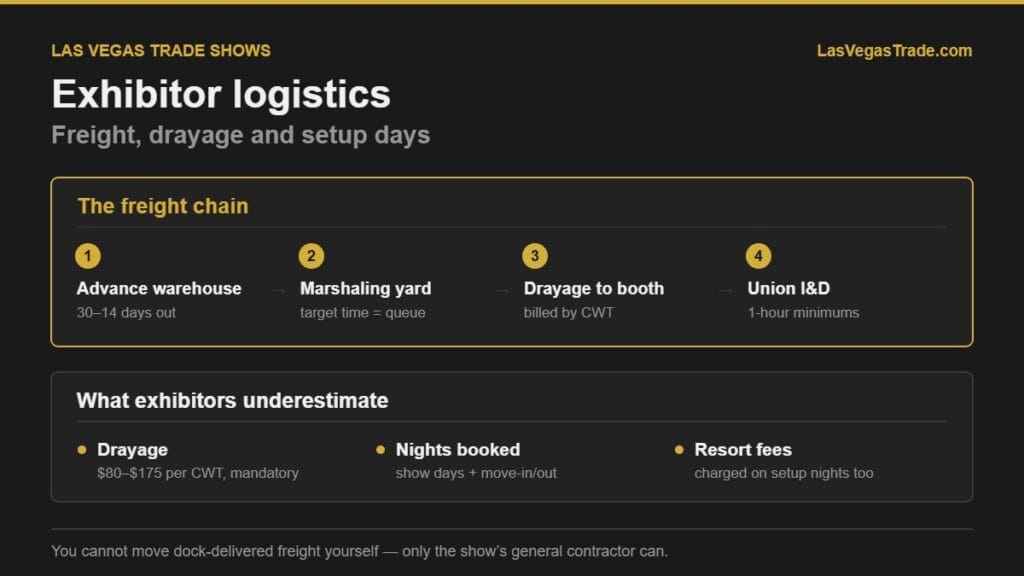
Drayage is not shipping. It is the separate, mandatory fee charged by the show’s general contractor to move your freight from the loading dock to your booth, store your empty crates during the show, and return them afterwards.
Two consequences follow. First, it is billed by weight — by hundredweight, or CWT — so a heavy crate costs more to move fifty metres inside the building than it did to cross three states. Reported rates at major US venues run roughly $80–$175 per CWT depending on venue and service level, with minimum charges applied per shipment. Second, you cannot opt out. Any freight arriving via the dock must be handled by the designated contractor. Your own staff cannot move it. Neither can your exhibit house.
At the LVCC, that contractor is typically Freeman or GES depending on the show. SEMA, for example, runs Freeman, with an advance warehouse window that opened September 24 and closed October 22 for the 2026 edition.
Advance warehouse or direct to show site?
This is the first real decision, and it is usually made badly.
Advance warehouse means shipping weeks early to the contractor’s warehouse. Your freight is received, confirmed and guaranteed to be at your booth when move-in starts. It costs more per hundredweight, and warehouses typically accept freight in a fixed window — commonly around 30 to 14 days out — with deliveries outside that window refused.
Direct to show site skips the warehouse fee, but requires your carrier to hit a specific target date and time at the marshaling yard. Miss it and you wait, or you pay a surcharge, or both.
For most exhibitors the advance warehouse is the safer economics: the fee difference is smaller than the cost of a booth that is not on the floor when the show opens. Direct-to-site makes sense when you have a reliable specialist carrier and a target time you trust.
The marshaling yard
Freight does not drive to the building and unload. Trucks check in at a marshaling yard, receive a freight door assignment, and are called forward in sequence. For SEMA, drivers must check in at the Freeman Marshaling Yard before proceeding to the LVCC.
The practical implication: your delivery time is a queue position, not an appointment. Early morning slots move faster than afternoon ones, which back up as the day progresses. Exhibitors who target early move-in windows consistently spend less time waiting.
Hand-carry: the one legitimate way to avoid drayage
Most shows permit exhibitors to hand-carry material they can physically carry in themselves. SEMA’s rule is representative: you may hand-carry if the display or product can be carried by hand, and only small two-wheel dollies are permitted.
This is genuinely useful for literature, samples, laptops and small display elements — and genuinely limited. It does not cover crates, pallets, or anything requiring a forklift or a four-wheel cart. Exhibitors who plan a booth around hand-carry usually discover the limit on move-in morning.
Union labour
Installation and dismantle at the LVCC is performed by union labour. Exhibitors cannot self-install beyond the hand-carry threshold, and labour is typically booked in minimum blocks of one hour.
Budget accordingly, and book labour in advance. Show services generally increase 10–25% after early-bird deadlines — one of the few costs entirely within your control.
Setup and teardown days: the hotel implication
This is where logistics meets your hotel booking, and where most exhibitor budgets quietly break.
Your stay is not the show. A four-day show can easily mean six or seven nights once you count move-in and move-out. Those shoulder nights matter for three reasons:
- They are often cheaper than show nights — but only if booked as part of the same reservation. Splitting a stay across two bookings at different rates is common and avoidable.
- The official housing block may not cover them. Blocks are built around show days; shoulder nights are sometimes unavailable inside the block, which is one of the clearest cases for booking independently.
- Resort fees apply to every night, including setup nights when you are on the show floor and never see the pool. At roughly $44 to $57 per night before tax (Las Vegas Review-Journal survey of Strip casino-hotels), two extra nights add about $88 to $114 per room before tax. See our guide to resort fees and waivers — teams contracting ten rooms or more can negotiate them away.
Where to stay when you are exhibiting, not attending
Attendee hotel advice optimises for the show floor. Exhibitor advice should optimise for the loading dock and a 6am start.
Concrete example: vendor crews staging LED walls and product activations for the Home Depot Store Managers Meeting at Mandalay Bay typically need to be on-property Saturday for a Tuesday show open. That means booking rooms for the full setup window, not just the show days, and putting Mandalay Bay or Delano on the crew calendar before Shoptalk buyers do the same.
- Proximity matters more, not less. On move-in day you may cross between hotel and hall several times. A property you can walk to beats a marginally cheaper one requiring a rideshare at 6am.
- Know your hall. The LVCC campus is large; the Vegas Loop connects the halls in about two minutes versus a fifteen-minute walk, and is free with your badge on show days. Which hall you are in should drive the choice.
- Consider no-resort-fee business hotels. The Paradise Road cluster — Courtyard, Renaissance, Hampton Inn, Residence Inn, SpringHill Suites — is built for exactly this: walkable, quiet, and frequently without the fees Strip resorts charge.
- Suites earn their cost on long builds. A kitchen and separate space matter more across seven nights with a team than across three as an attendee.
A working timeline
- 6–9 months out: secure booth space. Book hotels the same week for major shows — walkable inventory sells out first.
- 90 days out: lock booth design. Changes after this point cost real money.
- 30–14 days out: ship to the advance warehouse inside the acceptance window. Confirm receipt in writing.
- 3–5 days out: confirm your target move-in time with the show’s freight desk.
- Move-in: arrive early. Morning yard slots clear faster.
- Move-out: file your outbound paperwork before you leave the floor. Freight left without a bill of lading goes to the forced carrier, at their rate.
Book your exhibitor stay
Compare all-in rates near the LVCC — setup nights included.
Compare rates→
Frequently asked questions
What is drayage and can I avoid it?
Drayage is the mandatory fee charged by the show’s general contractor to move freight from the loading dock to your booth, store empties, and return them after the show. You cannot avoid it for dock-delivered freight — only the designated contractor may handle it. Hand-carried items you can physically carry in yourself are generally exempt.
How much does drayage cost?
It is billed by hundredweight (CWT). Reported rates at major US venues run roughly $80–$175 per CWT depending on venue, service level and whether freight came via the advance warehouse or direct. Minimum charges apply per shipment. Confirm current rates in your show’s exhibitor service manual.
Should I ship to the advance warehouse or direct to show site?
Advance warehouse for most exhibitors: freight is received and confirmed ahead of time, and guaranteed at your booth for move-in. Direct-to-site avoids the warehouse fee but requires hitting a precise marshaling yard target time.
Can I set up my own booth in Las Vegas?
Only within hand-carry limits. Installation and dismantle at the LVCC is union labour, typically booked in one-hour minimum blocks.
How many nights should exhibitors book?
Count move-in and move-out days, not just show days. A four-day show frequently means six or seven nights. Book them as a single reservation, and remember resort fees apply to every night.
The short version
Drayage is mandatory, billed by weight, and larger than new exhibitors expect. The advance warehouse is usually worth its premium. Marshaling yard timing is a queue, not an appointment. And your hotel booking should cover setup and teardown nights from the start — booked as one stay, compared on all-in cost including resort fees.
Rates, contractors and warehouse windows vary by show and change annually. Figures here reflect reporting available in July 2026; always confirm against your show’s official exhibitor service manual.
Union labor rules are a core part of exhibitor logistics at the LVCC. See our full guide to LVCC union rules for exhibitors for what your team can do yourself and how to cut labor costs.